
Brand architecture · 5 min read
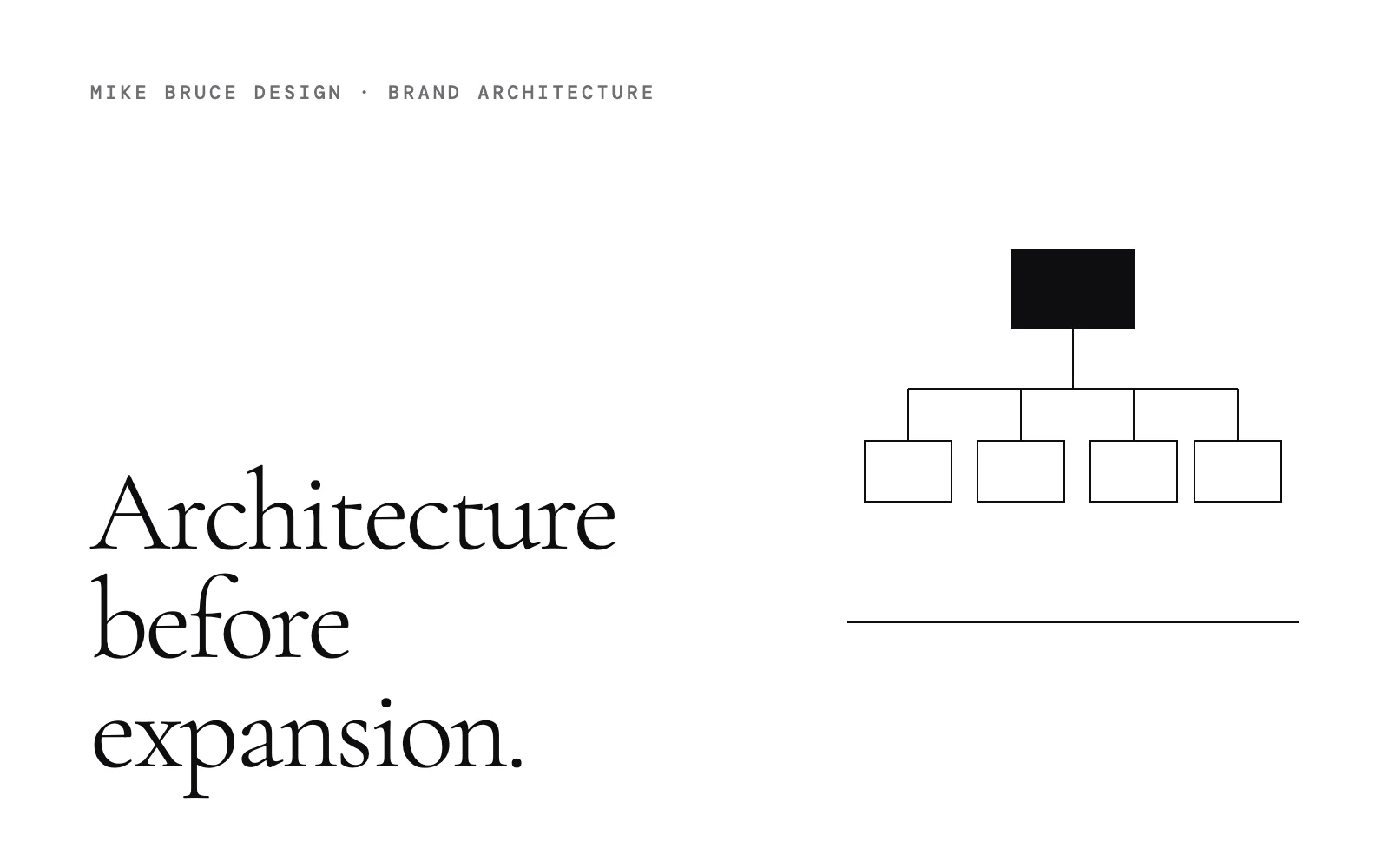
Brand architecture comes before expansion, not after.
Every new brand, market or acquisition is an architecture decision. Most companies make it by accident, one launch at a time.
 Mike Bruce · Brand Growth Architect
9 October 2026
Groups rarely set out to build a messy portfolio. It happens one reasonable decision at a time. A new product line gets its own name. An acquisition keeps its logo. A new market gets a local agency and a slightly different story. Five years later, the group runs five brands on five systems, and nobody can say what it stands for.
The cost is real. The brands compete for budget, confuse buyers and duplicate the same work five times. Worse, the group cannot lend its credibility to the brands that need it, because the market cannot see the connection.
Decide before you launch
Brand architecture is the set of decisions about how brands relate to each other and to the parent. Which brands lead? Which are endorsed by the group? Which should merge? It is far cheaper to answer those questions before a launch than to unpick them after.
Every launch is an architecture decision, whether you make it or not.
Siblings, not strangers
Related brands should share DNA and keep their own personality. Grills In & Out and Cocktails In & Out are a good example: two hospitality brands from one founder. Grills In & Out is the experience: craft, fire and ownership. Cocktails In & Out is the celebration: nocturnal, cinematic and luxurious.
They share clean lines, premium execution and an Abuja-rooted, globally aspirational point of view. Each has its own logo system, palette and voice. A customer can tell they are family, and can tell them apart.
Share the system, not just the logo
The real savings in a portfolio come from what sits underneath the logos: shared tokens, templates, standards and governance. When every brand runs on one system, a new brand launches inside it instead of beside it, and the portfolio costs less to run with every addition.
- Map every brand, the buyer it serves and the role it plays.
- Decide the architecture with evidence: lead, endorse or merge.
- Build one shared system of standards and templates.
- Govern it, so the next launch or acquisition enters the system on day one.
Our page on multi-brand groups sets out how the Brand Growth OS™ applies to a portfolio.