Market entry · 6 min read
Entering a new market? Your brand arrives before you do.
Before your first meeting in a new territory, the buyer has already met you: the website, the deck, the LinkedIn page. In a market that has never heard your name, that is the whole of your reputation.
 Mike Bruce · Brand Growth Architect
9 October 2026
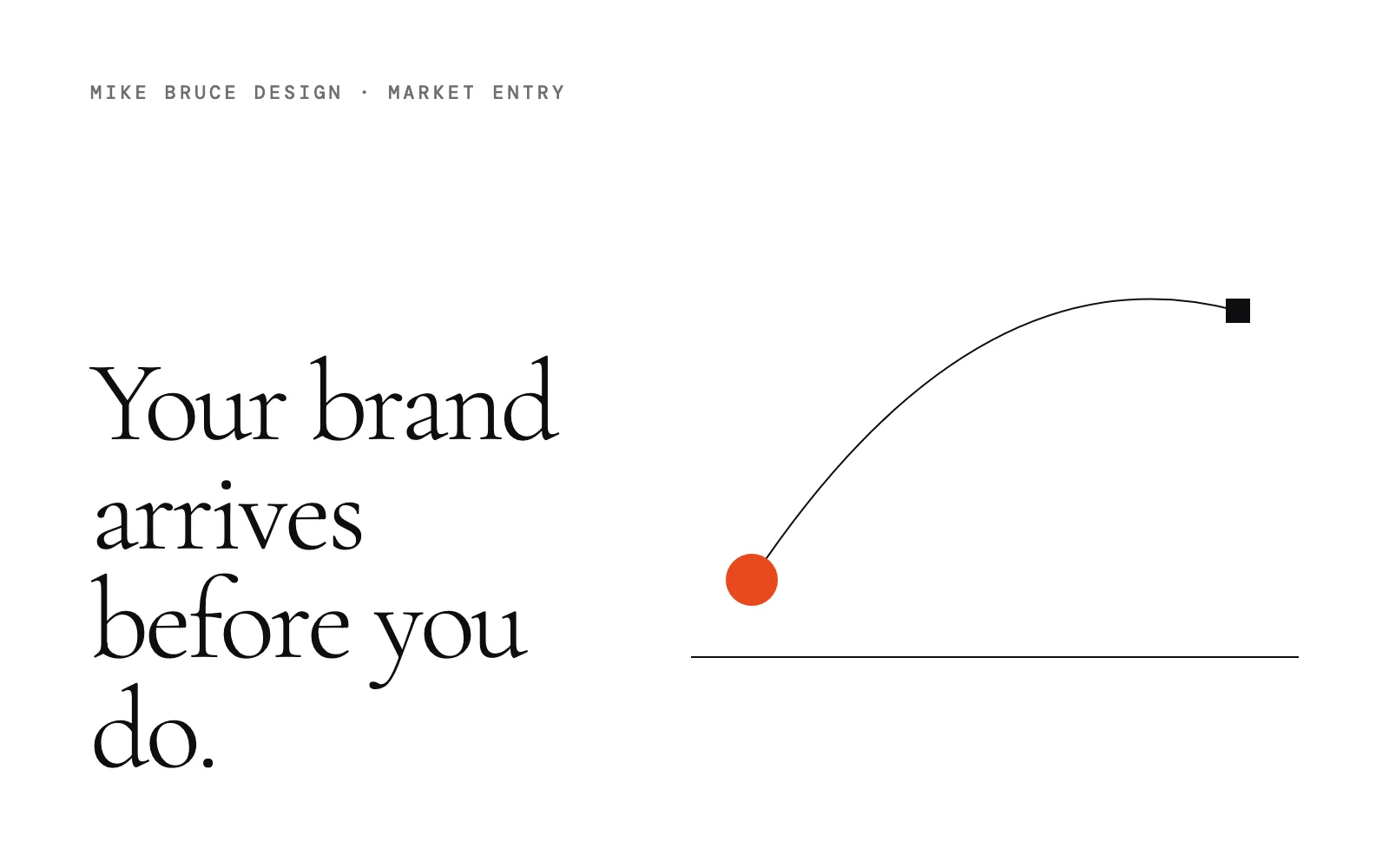
At home, your brand gets help. Buyers fill its gaps with what they already know. They know the founder. They know someone who used you. They remember the project you delivered five years ago. A vague website or an inconsistent deck doesn't cost much, because the reputation does the selling.
In a new market, nobody fills the gaps. The buyer has your materials and nothing else. Every inconsistency reads as a risk. Every generic claim reads as a company with nothing specific to say. The sales cycle stretches while buyers work out who you are, and many of them stop working it out.
The mistake: treating entry as translation
Most companies prepare for a new market by translating. The deck gets localised, the website gets a country page, the brochure gets new currency. The position underneath stays exactly as it was at home.
Translation is not the problem. Legibility is. A position that worked at home often depended on context the new market doesn't have: a category everyone at home understood, a competitor everyone at home disliked, a reputation everyone at home had heard of. Remove the context and the sentence stops meaning anything.
Your positioning is not the same sentence in a new language. It is the same idea, made legible to a new buyer.
What to settle before you launch
One position, expressed per market
You rarely need a new brand for each country. Separate brands multiply cost and split the equity you are trying to build. What you need is one position, settled once, and expressed for each market's buyer: what they are comparing you against, what makes them start looking, what they need to see before they trust a name they don't know.
Proof the new market trusts
Proof doesn't travel equally. A client name that opens doors at home may mean nothing abroad. Choose proof points for the market you are entering: results the new buyer can understand without context, and evidence they can check.
An identity other people can reproduce
In a new market, more of your brand is made by people who were not in the room: a country manager, a local agency, a distribution partner, a new sales hire. If the identity only holds when your head office touches it, it will drift within a quarter. Standards are not bureaucracy. They are how the brand survives distance.
A route the buyer actually takes
Buyers in different markets search, compare and decide differently. Map the route a buyer takes from first hearing of you to signing, in that market, and make sure every step carries the same position and hands them forward. Then build the website and channels around that route, not around your organisation chart.
Nigeria, the UK, the US and across Africa
Every market has its own first impression to win. For international companies entering Nigeria, the brand has to establish credibility and permanence quickly, in a market where trust often travels by referral. For African companies entering the UK or the US, the brand competes on clarity in mature, crowded markets, where buyers compare you with established incumbents within seconds. For companies expanding across African markets, one position has to hold across different buyers, languages and channels.
The work is the same in each case. Settle the position. Make it legible. Build the system that carries it, so it arrives in the new market already complete.
Where to start
Start before launch, ideally while the market entry plan is still being written. Positioning decisions shape pricing, partners and hiring. Start after launch and you rebuild assets that are already in market, in front of the buyers you were trying to impress.
If you are planning an entry, the Brand Growth Audit™ gives you a baseline in six minutes, and our market entry page sets out how the system applies.
From the work