Voices · 5 min read
Al and Laura Ries: a brand wins by owning one place in the customer's mind.
Al Ries (1926-2022) and Jack Trout are credited with reviving positioning, the idea that a brand lives in the customer's mind, and Al's daughter Laura Ries is president of their firm Ries & Ries. For founders, the point is plain: pick one idea and own it.
 Mike Bruce · Brand Growth Architect
3 November 2026
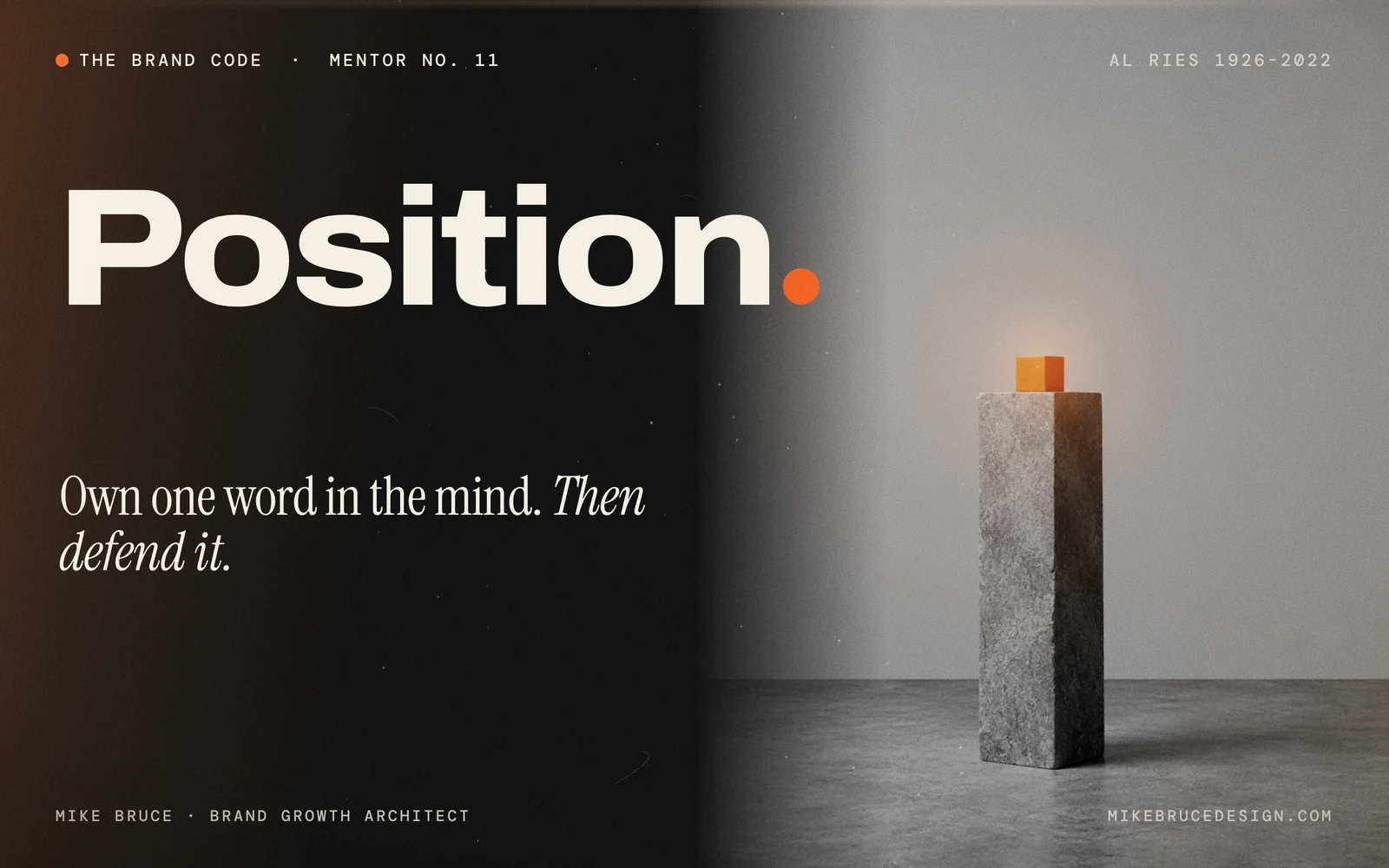
Al Ries was born on 14 November 1926 in Indianapolis and died on 7 October 2022 in Atlanta, aged 95, according to Wikipedia. One obituary describes him as almost 96, so sources differ by a few weeks of age; I use 95, as most do. This is a tribute to his work, so I do not tag him. His daughter Laura Ries, who is living per Wikipedia, is president of the firm they co-founded, Ries & Ries.
Why do Al and Laura Ries matter to a brand builder?
Because they made one idea famous and plain: a brand is not what you say, it is the place you hold in someone's mind. Ries and Jack Trout wrote a 1969 article in Industrial Marketing and a three-part 1972 series in Advertising Age, then the 1981 book Positioning: The Battle for Your Mind. Storyboard18's obituary reports that it sold over four million copies. Scholars disagree about who first coined the idea. Wikipedia's positioning page notes that some credit David Ogilvy in the 1950s and that Ries and Trout "resurrected" the concept and made it their trademark.
What are their key ideas?
- Positioning happens in the customer's mind. People are overwhelmed by messages, so they keep what fits a slot they already have.
- Find a window in the mind. Ries and Trout described positioning as an organised system for finding one.
- Focus. Al's 2005 book Focus argues that a company's future depends on narrowing what it stands for.
- Branding laws. With Laura he wrote The 22 Immutable Laws of Branding (2012) and, in 2004, The Origin of Brands. Laura's later books include Visual Hammer (2015).
My take: the idea I use
This is opinion. The Ries lesson I use most is that a small brand does not lose because it is weak. It loses because it is blurry. A founder who says "we do everything for everyone" has given the customer nothing to remember.
It maps to the first step of the Brand Growth OS™: Clarify. Choose the one thing, then Construct every signal around it. My one caution: positioning is not a slogan. It is a decision about what you will not be.
If the customer cannot say what you are for, you are not positioned yet.
How do you apply it?
- What one idea do we want to own? Write it in a sentence a customer would repeat.
- What are we willing to stop saying? Every extra claim blurs the one that matters.
- Do our name, look and words all point at it? Check your site, pack and social side by side.
Use the Positioning Statement Builder to draft it, and the Brand Growth Audit™ to see where it blurs. For related views read Byron Sharp and Kevin Lane Keller, or see all brand voices.
Sources
Wikipedia: Al Ries · Wikipedia: Laura Ries · Wikipedia: Positioning (marketing) · Storyboard18 obituary. Opinion is Mike Bruce's; this is a profile of published work, not a claim of personal contact. See all brand voices · About Mike Bruce.