Voices · 5 min read
Kevin Lane Keller: a brand lives in the customer's mind, so build it in order.
Kevin Lane Keller is the E. B. Osborn Professor of Marketing at Dartmouth's Tuck School of Business, and his 1993 Journal of Marketing paper defined customer-based brand equity. His point for founders: a brand is what customers know and feel about you, and it is built in a set order, from being known to being loved.
 Mike Bruce · Brand Growth Architect
1 November 2026
Kevin Lane Keller is the E. B. Osborn Professor of Marketing at the Tuck School of Business at Dartmouth College, according to Wikipedia and Tuck's own profile. He studied at Cornell, Carnegie Mellon and Duke. His textbook Strategic Brand Management first appeared in 1998, and he co-authors Marketing Management with Philip Kotler.
Sources differ slightly on the latest edition of Strategic Brand Management: Tuck dates the fifth edition, written with Vanitha Swaminathan, to 2019, while the reference on Wikipedia gives 2020. Tuck describes it as the best-selling branding textbook and lists companies he has advised, including Accenture, American Express, Disney, Intel, Nike, Procter & Gamble and Samsung.
Why does Kevin Lane Keller matter to a brand builder?
Because he gave brand equity a definition you can work with. His 1993 Journal of Marketing paper, "Conceptualizing, Measuring, and Managing Customer-Based Brand Equity", had been cited more than 4,000 times by August 2019, according to Tuck. Where David Aaker looked at brand equity as an asset a company owns, Keller looked at it from the customer's side: what people know about you, and how that changes the way they respond.
What are his key ideas?
- Brand equity lives in the customer. In the 1993 paper, a brand has equity when people know it and hold strong, favourable and unique associations with it. Those associations change how they react to everything you do.
- Brand knowledge has two parts. Awareness (do they know you, and think of you at the right moment?) and image (what comes to mind when they do).
- Brands are built in steps. His 2001 Marketing Science Institute paper sets out four steps: establish identity, create meaning, draw out the right responses, and forge relationships, built from six blocks.
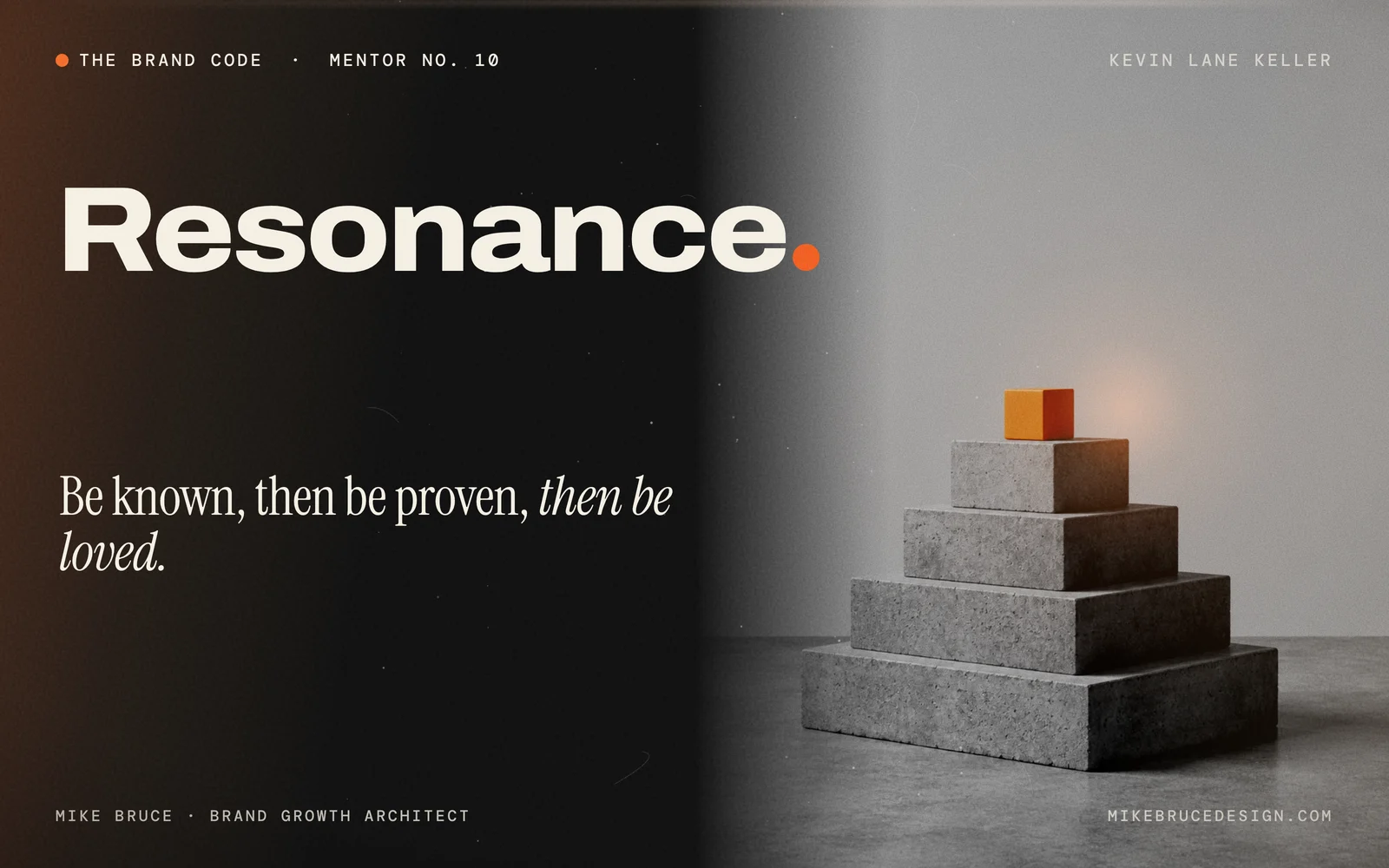
- The resonance pyramid. Those six blocks are commonly summarised as salience, performance, imagery, judgements, feelings and, at the top, resonance: loyalty, attachment and advocacy.
My take: the idea I use
This is opinion. Keller's most useful gift to a founder is the order. Most small businesses try to start at the top of the pyramid. They want loyalty, community and referrals before the market clearly knows what they do.
Resonance is earned, not announced. You cannot ask people to love a brand they cannot describe. So I work up the pyramid the way the Brand Growth OS™ is built: Clarify (salience: are we known, for the right thing, by the right people?), Construct (performance and imagery: does the product deliver, and does the brand look like what it promises?), Connect (judgements and feelings: do people trust us and like dealing with us?), and Convert (resonance: do they come back and bring others?).
Customers cannot love what they cannot describe. Be known, then be proven, then be loved.
How do you apply it?
- Do the right people know what we are for? Ask ten target customers to describe you in one sentence. If the answers scatter, the base of the pyramid is not built.
- Does our proof match our promise? Check that the product, the service and the look of the brand all say the same thing.
- What do we give loyal customers a reason to do? Resonance needs an action: a repeat order, a referral, a review. Name it and make it easy.
The Brand Growth Audit™ shows which level of the pyramid is holding your brand back, and the Positioning Statement Builder helps you fix the base. For other views of brand value, read David Aaker on brand equity and Byron Sharp on how brands grow, or see all brand voices.
Sources
Wikipedia: Kevin Lane Keller · Tuck School of Business: Inventing the Edge, Kevin Lane Keller · Marketing Science Institute: Building Customer-Based Brand Equity (2001) · Keller, K. L. (1993), "Conceptualizing, Measuring, and Managing Customer-Based Brand Equity", Journal of Marketing 57(1), 1-22. Opinion is Mike Bruce's; this is a profile of published work, not a claim of personal contact. See all brand voices · About Mike Bruce.