Voices · 5 min read
Marty Neumeier wrote a novel. Read it as a brand lesson.
Marty Neumeier wrote the book on brand gaps and zags. His first novel, Octavo, is set in the Venetian press that made the small book a brand. Marty sent me an advance manuscript before it launched. Here is what the story's world teaches about brand.
 Mike Bruce · Brand Growth Architect
23 October 2026
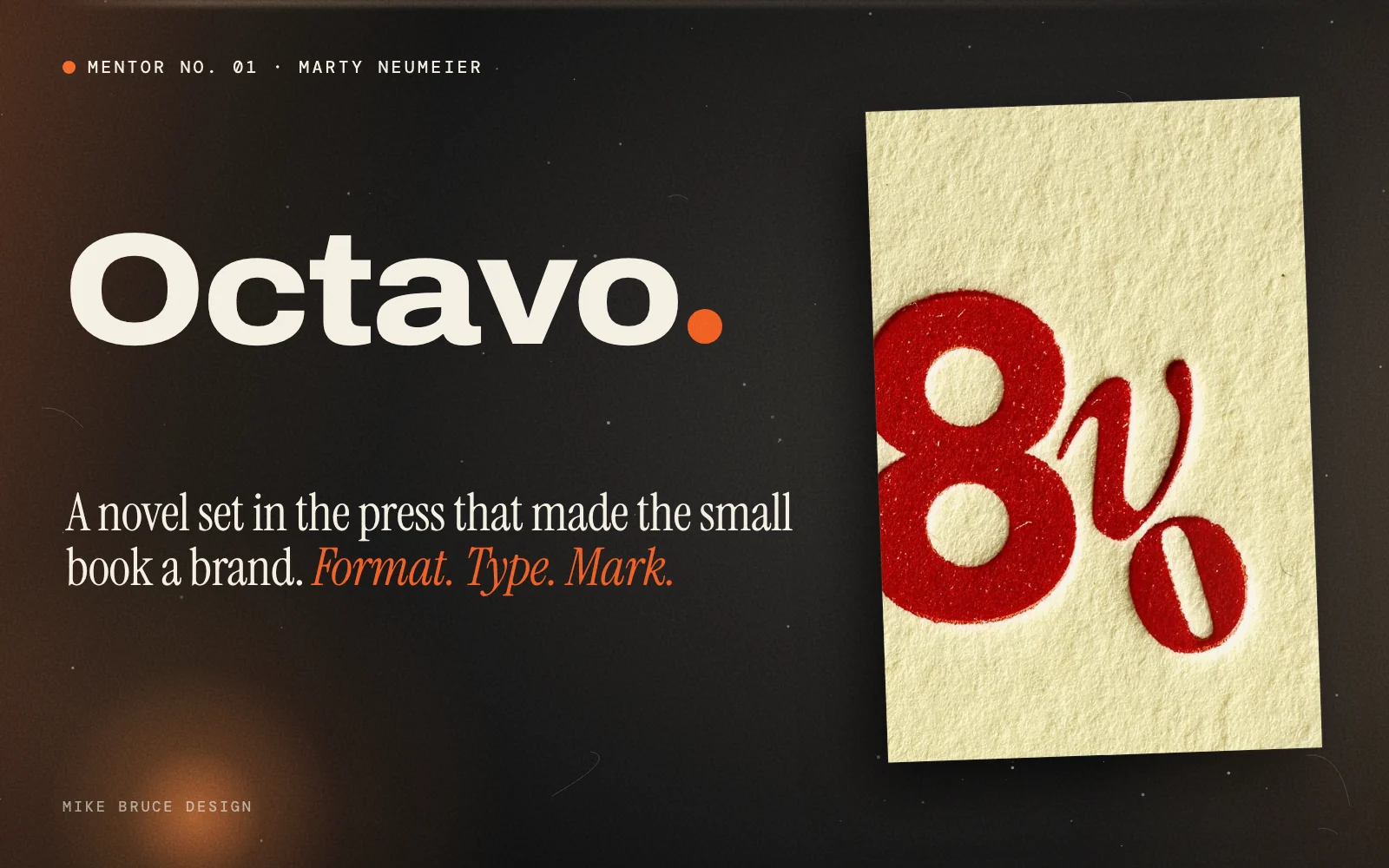
Marty Neumeier is the author most branding people reach for first. The Brand Gap gave the industry a plain definition: a brand is a person's gut feeling about a product, service or company. Zag told us to differentiate, not decorate. So when he published a novel, I paid attention.
I have to be straight about my part. Marty sent me an advance manuscript of Octavo to review before it launched. I am grateful for that, and I will not spoil the story here. This piece is about something else: the world the book is set in, and why a brand person should care about it.
What Octavo is
Octavo is Marty's first novel, published in October 2025. It is a historical mystery and a modern thriller in one. In the present day, two people find a manuscript written by Leonardo da Vinci's last pupil. In the past, a murder takes place at the Aldine Press in Venice, the printing house of Aldus Manutius.
The title is a printing term. An octavo is a sheet folded three times to give eight leaves. It is the size of most books you own.
The press that made a small book a brand
Aldus Manutius did not invent the octavo. Other printers used it before him, mostly for prayer books. What he saw was what it could do for the classics: a book small enough to carry, in a type clean enough to read anywhere. Historians still argue over how original each piece was. The branding lesson does not depend on who was first. It depends on what he did with it.
- He chose a format. A smaller book changed who could own one and where it could be read. Format is a brand decision before it is a design decision.
- He owned a typeface. The press is credited with popularising italic type, cut with the engraver Francesco Griffo. A letterform people recognise before they read a word is identity at its simplest.
- He put a mark on every book. The dolphin wrapped around an anchor appeared on Aldine books. Its motto, festina lente, means "make haste slowly". The anchor is steadiness and the dolphin is speed. That is a positioning line, five hundred years old.
A brand is not what you say it is. It is the gut feeling your choices leave, repeated until it is trusted.
My take
I will not pretend to know why a brand author turned to fiction. What I notice is the setting. Of every workshop in the Renaissance he could have chosen, Marty chose the one that behaved like a modern brand: one clear promise, a signature look, and a mark that told a stranger what to expect before they opened the cover.
Most founders I meet do the opposite. They add products, add colours, add claims. The Aldine Press did fewer things and did them recognisably, and that is why we still talk about it.
That is also how I work with clients. In the Brand Growth OS™, Clarify settles the promise, Construct turns it into a format, a type and a mark, Connect puts it where buyers already are, and Convert measures what it earned. Aldus ran the same loop with lead type.
Three questions for your own brand
- What is your format: the shape of your offer that makes you easy to carry into a room you are not in?
- What is your type: the look or sound that is recognisably yours before the name appears?
- What is your mark: the one promise, in a few words, that you repeat everywhere?
If you cannot answer all three in a sentence each, start with the Positioning Statement Builder, or run the Brand Growth Audit™ to see which phase is weakest.
About Marty Neumeier
Marty Neumeier is an American author, designer and speaker on brand, design and innovation. He studied at Art Center College of Design, spent years in advertising and brand design in Southern California, and moved to Silicon Valley in 1984, where his clients included Adobe, Apple and Hewlett-Packard. In 1996 he founded Critique, a magazine about design thinking. His books include The Brand Gap, Zag, The Designful Company, Metaskills and The 46 Rules of Genius. Octavo is his first novel; listings give publication dates of 9 to 22 October 2025 for the different editions.
Read more: Marty Neumeier on Wikipedia · Octavo on Goodreads · an independent review of Octavo · the Aldine Press and its dolphin and anchor.
This is the first in a series on the people whose work shaped how I think about brand. See all brand voices · More about Mike Bruce.
Keep reading