Industry take · 5 min read
Coca-Cola pruned its brands. Here is what to copy.
On 22 October 2026 Coca-Cola named Omnicom its North American media agency and restructured its agency roster. At a conference the day before, its global CMO said the company cut its portfolio from more than 400 brands to about 170. The lesson for a smaller business is the same: focus first, then spend.
 Mike Bruce · Brand Growth Architect
23 October 2026
On 22 October 2026 Coca-Cola selected Omnicom as its media partner in North America. According to Marketing Dive, WPP Open X keeps global media outside North America and stays its global creative partner, and Dentsu continues in Japan and South Korea. The new structure begins in phases on 1 December. Publicis, which won the North American media account last year, withdrew from the review after taking on PepsiCo's global media work.
What did Coca-Cola's CMO say?
At the ANA Masters of Marketing conference on 21 October, global chief marketing officer Manolo Arroyo described what he found when he started in early 2020: almost two decades of little growth in the consumer base, slow adoption of digital marketing, and a company spread thin, with about 2,000 marketing programmes, 3,000 product launches a year and more than 6,000 agencies.
His answer, as Marketing Dive reports it, had four parts: prune the portfolio from more than 400 brands to about 170 (32 of them billion-dollar brands), pursue bigger innovation, move to digital, and redesign the marketing operating system. He also said the company changed its main metric from brand love to total consumer base, a behavioural measure, and credited the changes with 160 million new consumers. That figure is Coca-Cola's own, as presented by Arroyo.
My take
This is opinion. The most useful number in the story is not 160 million. It is 6,000 agencies. A company that size can hold that much fragmentation for years because it has the scale to absorb the waste. A small company cannot.
Look at what the changes are. Fewer brands is Clarify: decide what each brand is for and drop the ones with no job. One operating system across agencies is Connect: everything carries the same position. A behaviour metric is Convert: measure what the brand produced, not how people felt about it. That is the Brand Growth OS™ loop running at the largest scale in the world.
One caution. Moving from brand love to a behaviour measure makes sense when attitude is hard to tie to a decision. But I would not drop attitude entirely, because behaviour tells you what people did, not why. Keep both, and use the attitude measure to explain the behaviour measure.
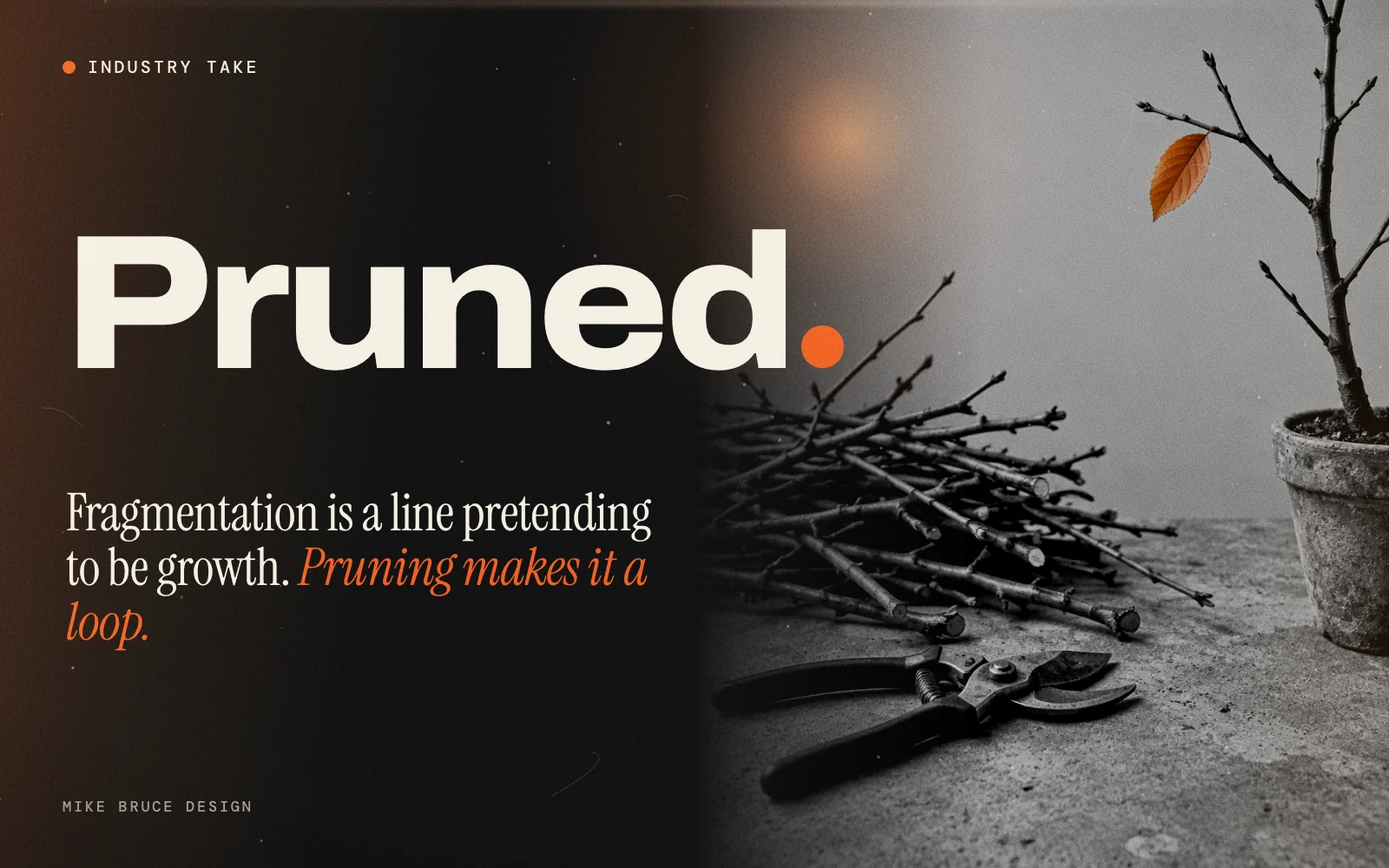
Fragmentation is a line pretending to be growth. Pruning is how you turn it back into a loop.
What should a founder copy?
You do not need to be a global brand to prune. Do these three things this quarter.
- List everything you sell and say about yourself. Offers, packages, taglines, channels. Most companies find more than they expected.
- Cut what does not serve one clear position. If you cannot explain why an item exists in one sentence, it is a candidate to drop or fold in.
- Choose one behaviour to measure, and one attitude to explain it. For example: enquiries from people who found you by name, and the reason they give for choosing you.
The architecture before expansion piece goes deeper on deciding what each brand in a group is for. The Sub-brand Decision tool helps with the cut, and the Brand Growth Audit™ shows where your own fragmentation sits.
Sources
Marketing Dive, 23 October 2026. Figures about brands, agencies and new consumers are Coca-Cola's own, as reported there. Opinion in this piece is Mike Bruce's. See all brand voices · About Mike Bruce.
Keep reading