Industry take · 5 min read
Oxford Street is "for everyone". Is that a position?
On 26 October 2026 a stretch of London's Oxford Street closed to traffic, and the street launched an identity called For Everyone. A brand that says it is for everyone breaks the first rule of positioning. Looking closely, it is doing something smarter, and there is a lesson in where it could still go wrong.
 Mike Bruce · Brand Growth Architect
30 October 2026
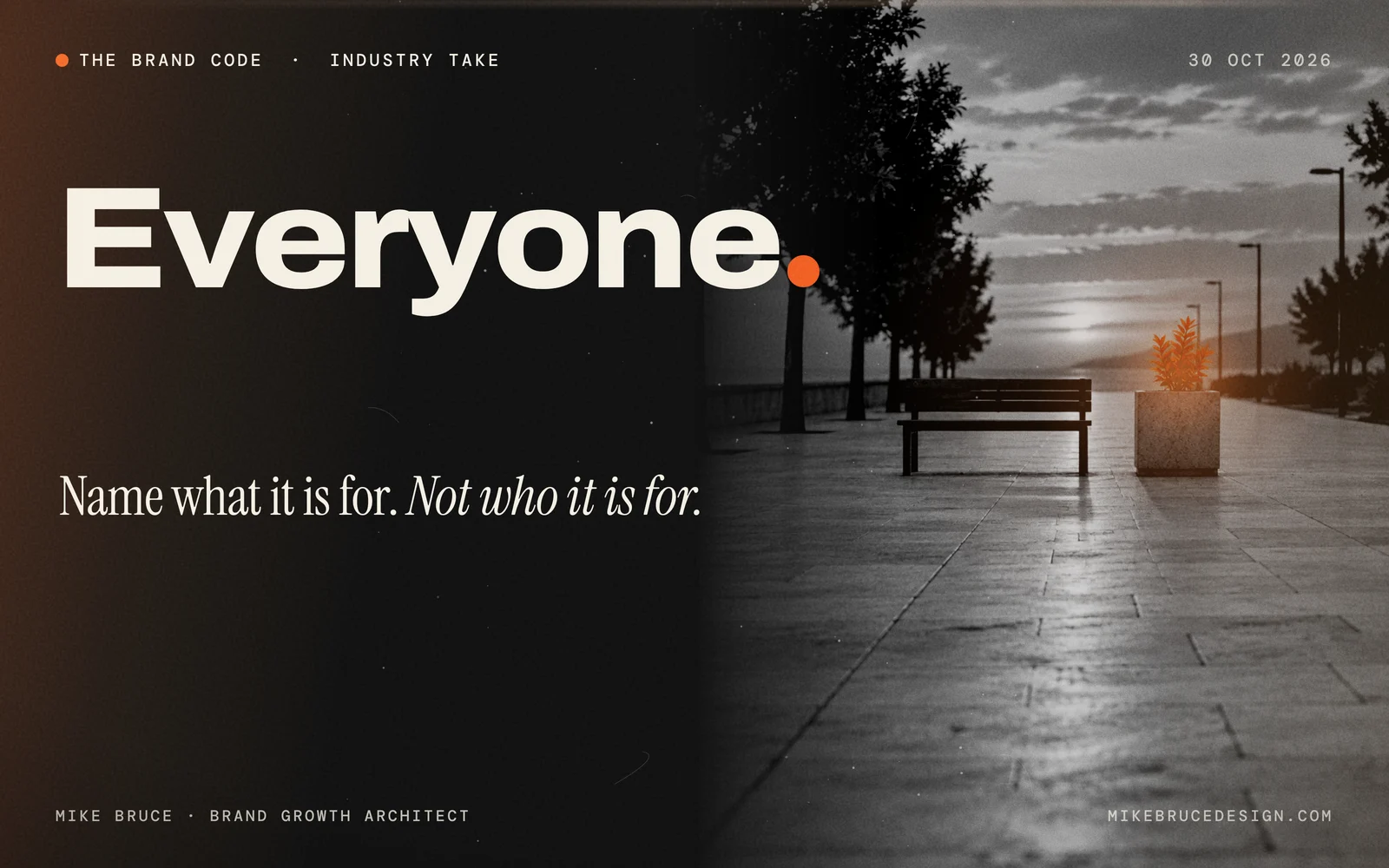
On Monday 26 October 2026 almost a kilometre of Oxford Street, from Orchard Street near Selfridges to Great Portland Street, became traffic-free, according to Time Out. It is a first phase and partly a trial. Temporary seating, planters and bollards are in place, and a larger redesign with permanent seating and trees is due next year after the Christmas rush.
The street also has a new identity. Creative Review and Time Out credit the studio Koto, working with the Oxford Street Development Corporation, for a brand called "For Everyone". The word "for" sits at the centre of the wordmark. Koto describes it as "for shopping and stopping". The system uses London Sans and London Serif typefaces and a green palette, with the line "Where London meets".
A note on sources. Design Week and Transform magazine describe an earlier identity for the Development Corporation itself, credited to the agency Anatomy. I have not seen how the two pieces of work relate, so I am describing only what Creative Review and Time Out report.
What are people saying?
Time Out reports that around two-thirds of people who answered the question in Transport for London's consultation backed the scheme. The Mayor of London, Sadiq Khan, called it a "momentous" new era. The London Taxi Drivers' Association has warned that restricting taxi access could isolate older and disabled passengers, and some locals worry about traffic moving to nearby streets.
My take
This is opinion. "For everyone" looks like the first mistake in positioning, because a promise to everyone is a promise to no one in particular. I would never let a business use it.
But a public street cannot choose its customers. What I like is the second half of the idea. "For shopping and stopping" names uses, not audiences. A founder can use the same trick: you may not be able to narrow who you serve yet, but you can narrow what you are for.
The risk is the one every launch faces. An identity is a promise, and a promise is tested by the product. The street is a trial with temporary furniture until next year. If someone visits this winter and finds benches and bollards, that is the brand. The logo is the smallest part of the experience.
The brand is not what you launch. It is what people find when they turn up.
Three questions before you launch an identity
- What are you for? Write it as uses, not audiences: "for shopping and stopping", not "for everyone".
- Can the product deliver it today? If the experience is half-built, say so, and launch the promise in stages.
- What will a first-time visitor actually find? Walk it yourself as a stranger.
This is the Clarify and Convert link in the Brand Growth OS™: the promise must match what the experience produces. The Positioning Statement Builder helps with the first question, and the Brand Growth Audit™ shows where your promise and your experience drift apart. I also wrote about Seth Godin's smallest viable audience, which is the other side of this argument.
Sources
Time Out, October 2026 · Creative Review, 29 October 2026. Opinion in this piece is Mike Bruce's. See all brand voices · About Mike Bruce.
Keep reading