Voix · 5 min de lecture
Ty Montague: stop telling the story and start doing it
Ty Montague's book True Story (published by the Harvard Business Review store in 2013) argues that the most successful companies are storydoers: they tell their story mainly through what they do, not through advertising. For a founder, it means every claim needs an action behind it.
 Mike Bruce · Brand Growth Architect
7 November 2026
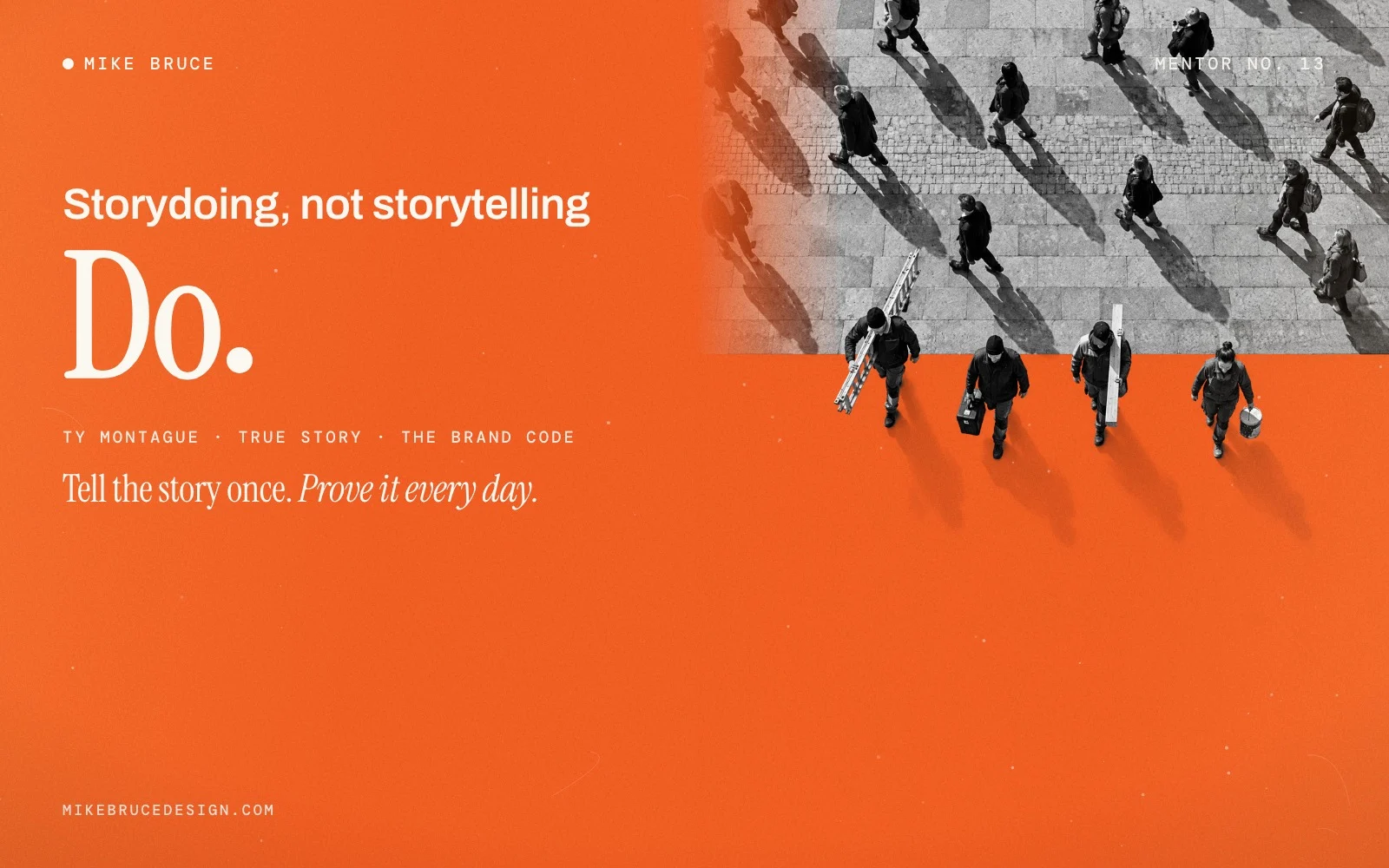
Ty Montague's book True Story: How to Combine Story and Action to Transform Your Business makes one argument that every founder should hear early: the story you tell about your company only counts if your actions tell it too. The Harvard Business Review store lists it at 240 pages, published 16 July 2013; some retailer listings give a later edition date.
Why does Ty Montague matter to a brand builder?
Montague came from the heart of advertising. The HBR store describes him as a former president and chief creative officer of J. Walter Thompson, and as a founder of the growth consultancy co:collective. That is what makes his argument interesting: a man from the biggest agency world saying that advertising alone is not enough.
In July 2013 he set out the idea in "Good Companies Are Storytellers. Great Companies Are Storydoers" on HBR.org, followed by a short series that included "If You Want to Raise Prices, Tell a Better Story".
Quelles sont ses idées clés ?
Storydoing. The best companies, in his view, are storydoers. Their products and services are the evidence of a story that means something, and they tell it mainly through action, not through ads.
The four truths and the action map. The book gives a framework to build that story. It names the participants (customers, partners and employees), the protagonist (your company as it is today), the stage (the world around your business), and the quest (the ambition and contribution you are driving at). The action map then lists what you will do to make the story real for those participants.
Examples. The book's description names Red Bull, Shaklee, Grind, TOMS Shoes and News Corporation as companies it studies.
The idea I apply: a claim without an action is just advertising
This is my opinion. Most founders have a story. It usually lives on the About page and in the pitch deck. The trouble starts when nothing a customer touches proves it. Picture it: the website says "personal service" and the enquiry form goes to a shared inbox. The deck says "premium" and the invoice arrives late with a typo.
Montague's frame fixes the order. Decide the quest first. Then design actions a customer can see, and only then talk about them. In Brand Growth OS™ terms, Clarify sets the story and Connect and Convert are where it is either done or broken. Certainty is the brand, and nothing builds certainty like a promise you watched someone keep.
Tell the story once. Prove it every day.
How to apply it: three questions
- What is our quest in one sentence? Not what you sell: the change you want to make for the people you serve.
- What three things does a customer see us do that prove it? If you cannot name three, the story is still only words.
- Which of our current messages has no action behind it? Cut it, or build the action first.
The brand messaging framework helps you write the story, and the customer journey map shows where it has to be acted out. The Brand Growth Audit™ checks whether what you say and what you do match. Montague's view sits well beside Wally Olins, who saw identity as the whole organisation. See all brand voices or about Mike Bruce.
Sources
True Story, HBR store · HBR.org, 16 July 2013 · HBR.org, 31 July 2013. Career details are as the HBR store describes them; we could not confirm them from a second source, and we have no current information on his role. Opinion is Mike Bruce's. See all brand voices.
Continuer la lecture