Industry take · 5 min read
John Lewis says 'Don't give up on giving'. Some viewers heard something else.
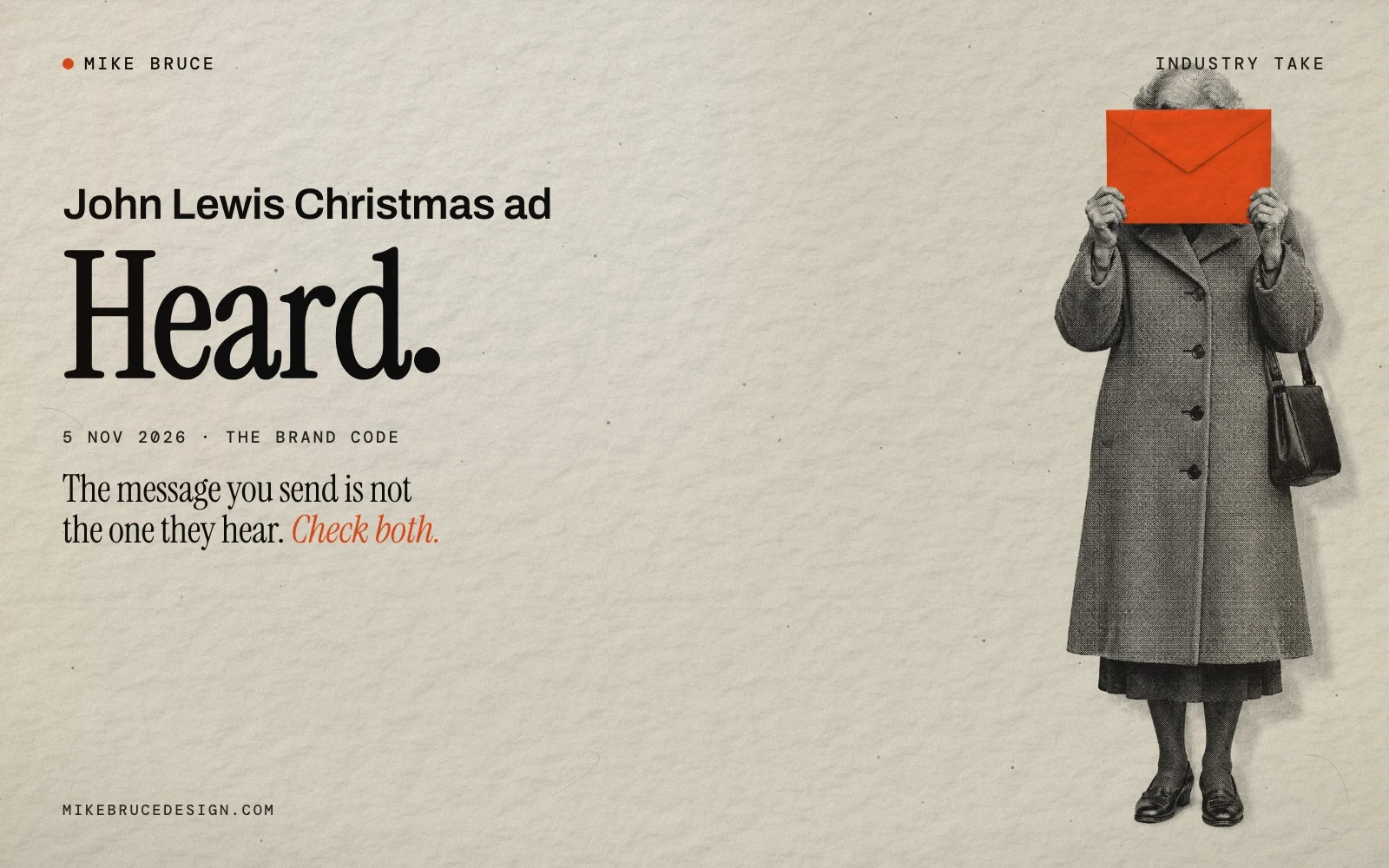
John Lewis released its 2026 Christmas ad, 'Gloria and Pickles', in the first days of November, and the reaction is split between praise for the cast and anger at the grandchildren. For any founder, the lesson is that people judge the message they receive, not the one you meant to send.
 Mike Bruce · Brand Growth Architect
5 November 2026
John Lewis released its 2026 Christmas ad, "Gloria and Pickles", in the first days of November 2026, and Reel 360, Brit Brief and Fashion Times all describe a split reaction. None of the three gives a clean launch date, so I am saying "early November" rather than guessing.
What happened?
Reel 360 reports that this is the retailer's 20th Christmas ad, created by Saatchi & Saatchi London and directed by Lucy Forbes. Kristin Scott Thomas plays Gloria, a grandmother who cannot decide what to give her grandchildren and starts slipping cash into their cards. A wooden toy dog, Pickles, voiced by Paul Whitehouse, tells her she can do better than cash. She builds the children a "Gran Cave" full of gifts. The tagline is "Don't Give Up on Giving", and the music is Sam Fender's cover of a Rolling Stones song.
John Lewis's marketing and loyalty director, Rosie Hanley, is quoted by Reel 360 saying the ad is about the connection you can create with family, not the price of a product.
What are people saying?
Brit Brief reports that Mumsnet users are almost united in disliking the two grandchildren, especially the moment they shake their cards expecting money. Fashion Times quotes columnist Sarah Vine and Piers Morgan as critics. Reel 360 says The Independent's Katie Rosseinsky called the campaign "tone deaf" given tight household budgets. On the other side, viewers praised the cast, the humour and the nostalgia.
The measurements do not agree with the mood online. Kantar's Lynne Deason is quoted by Brit Brief and Reel 360 saying the ad lifts the festive feeling but lacks the "emotive punch" of earlier years, and that the branding could be stronger. Fashion Times reports a System1 score of 5.6 stars, the retailer's strongest since 2019, and a OnePulse finding that 68% liked or loved it, but also that 58% of respondents said it would make no difference to where they shop. I could not open the System1 or OnePulse research myself, so treat those figures as Fashion Times's reporting.
My take: a message is what the audience takes away
This is opinion. John Lewis says the story is about thoughtful giving. A fair share of viewers watched a rich family, a spoilt pair of children and a grandmother who wins their attention by building a room full of presents. Both readings come from the same film. The company only controls the first one.
You do not decide what your brand means. Your customers do, from the signals you give them.
The useful detail is the gap between a test score and a conversation. A test can tell you how people felt in the moment. It cannot tell you what they repeat at the school gate, and the repeating is where a brand lives. In Brand Growth OS™ terms, this is a Connect question: the message has to land the way you meant it with the people you serve, in the world they actually live in.
I am not saying the ad is bad. The cast and the craft are praised even by critics, and the scores are strong. I am saying that a brand built on trust is judged on what its story implies, and a mismatch between the setting and the customer's life costs more than a weak joke.
What should a founder do about it?
- What does our story imply, read by the least generous viewer? Show your message to someone who does not already like you and ask what they think you believe.
- Does the world in our content look like our customer's world? Check the home, the budget, the problem and the language. If it looks richer, easier or neater than real life, say why.
- What are we measuring: feeling or action? A good reaction is not the same as a changed habit. Decide which one you need before you read the numbers.
The Brand Growth Audit™ checks whether your signals say what you think they say, and the Positioning Statement Builder helps you pin down the one thing you want people to repeat. Earlier this week: who owns your name when the deal changes. See all brand voices or about Mike Bruce.
Sources
Reel 360 · Brit Brief · Fashion Times, all early November 2026. Opinion is Mike Bruce's; facts are as reported by those outlets, and the John Lewis release, Kantar, System1 and OnePulse originals were not opened. See all brand voices.