Branchenanalyse · 4 Min. Lesezeit
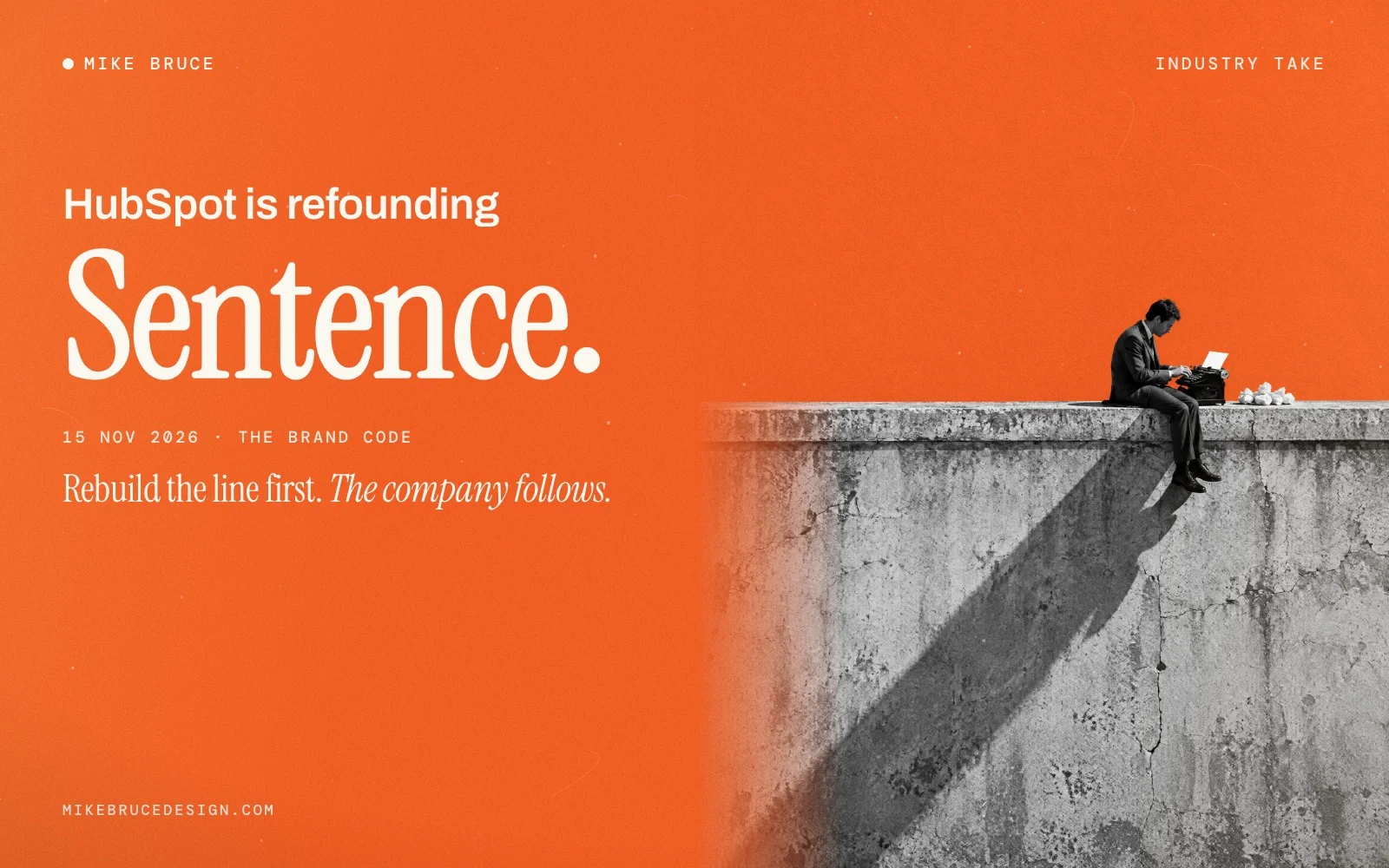
HubSpot is refounding. The first thing it needs is a sentence.
On 12 November 2026 HubSpot brought back co-founder Brian Halligan as chief executive to lead what it calls a refounding of the company. The founder's lesson: before you rebuild the product, rebuild the one sentence that says what you are for.
 Mike Bruce · Brand Growth Architect
15 November 2026
On Thursday 12 November 2026, HubSpot announced that its co-founder Brian Halligan was back as chief executive, effective the same day, to lead what the company calls a "refounding". Yamini Rangan, chief executive since 2021, stepped down. For any founder whose business has drifted from the idea that built it, this is worth reading closely.
Was ist passiert?
According to HubSpot's own announcement, Halligan will rethink the company from the ground up across product, go-to-market and culture. He frames HubSpot's story in three chapters: first, creating the inbound marketing category; second, building a CRM platform; third, building what the company calls "the customer relationship harness". The announcement does not yet explain that phrase in detail.
Rangan leaves the chief executive role and the board but stays until 1 December to hand over. HubSpot credits her with growing customers from about 135,000 to more than 311,000 since 2021. The company also named Karen Burgess, from Adobe, as its next chief financial officer, succeeding Kate Bueker, whose retirement it describes as long planned.
Halligan co-founded HubSpot with Dharmesh Shah and ran it for 16 years before stepping down in 2021. Sources differ on the founding year: HubSpot says 2005, while Wikipedia says 2006. Halligan and Shah are credited with popularising the term "inbound marketing" and co-wrote a 2009 book of that name.
Was sagen die Leute?
HubSpot gave no reason for the change. CMSWire calls the exit abrupt and lists the pressure of 2026: a pricing change for its AI agents, a guidance cut in August and a workforce cut in October. The Next Web, citing Bloomberg, reports that shares had roughly halved this year amid fear of AI-native rivals, and that Halligan said the company may have chased short-term financial targets over great products. Both outlets read the move as a race to reposition for AI. That reading is theirs; HubSpot has not set out the plan.
My take: a refounding is a positioning job first
This is opinion. As I read it, HubSpot's breakthrough was a word, not a feature. It named a way of doing things, inbound, and made the word its own. The word told marketers what HubSpot was for. That sentence was the brand.
Twenty years and a lot of products later, the sentence got harder to say. "Inbound" became a chapter, the CRM became a platform, and AI arrived to make every platform sound the same. A refounding is the founder admitting the sentence is gone. The product work matters, but it comes second. If customers cannot repeat what HubSpot now stands for in one line, a new product only adds features to a story nobody can tell.
Founders do not rebuild companies. They rebuild the sentence, then the company follows.
"Customer relationship harness" is not that sentence yet. It is an internal phrase waiting for a meaning customers can feel. That is fair on day one. The test is whether, in a year, a marketer can explain it to a colleague without a slide. In Brand Growth OS™ terms this is Clarify before Construct: certainty about what you are for has to exist before you build anything new on top of it. Positioning is still the first job, even for a company worth billions.
Was sollte ein Gründer damit tun?
- Write your founding sentence. What did you say when the business started that made people get it straight away? Write it down word for word.
- Test whether it is still true. Ask three recent customers what you do. If their answer has drifted from your sentence, the drift is the problem, not the product.
- Fix the sentence before the roadmap. Agree one new line for what you are for, then judge every new product, service and hire against it.
Choose the ground you want to own with the free category choice tool, then sharpen the line with the positioning statement builder. If the business leans too hard on you as founder, try the founder dependency check. The Brand Growth Audit™ shows where your story has drifted. See all brand voices or about Mike Bruce.
Quellen
HubSpot, leadership transition announcement (12 Nov 2026) · CMSWire, Dom Nicastro (12 Nov 2026) · The Next Web, Cristian Dina (12 Nov 2026, citing Bloomberg) · Wikipedia, Brian Halligan. Opinion is Mike Bruce's; facts are as reported by those sources. See all brand voices.

Über den Autor
Mit Mike Bruce arbeiten.
Mike Bruce ist Markenberater und Markenstratege in Abuja, Nigeria, und Gründer von Mike Bruce Design. Er hilft wachsenden Unternehmen in Nigeria, Großbritannien und den USA, klar zu wissen, für wen sie da sind, Preise nach dem geschaffenen Wert festzulegen und gewählt zu werden.
Weiterlesen