行业观点 · 阅读约 5 分钟
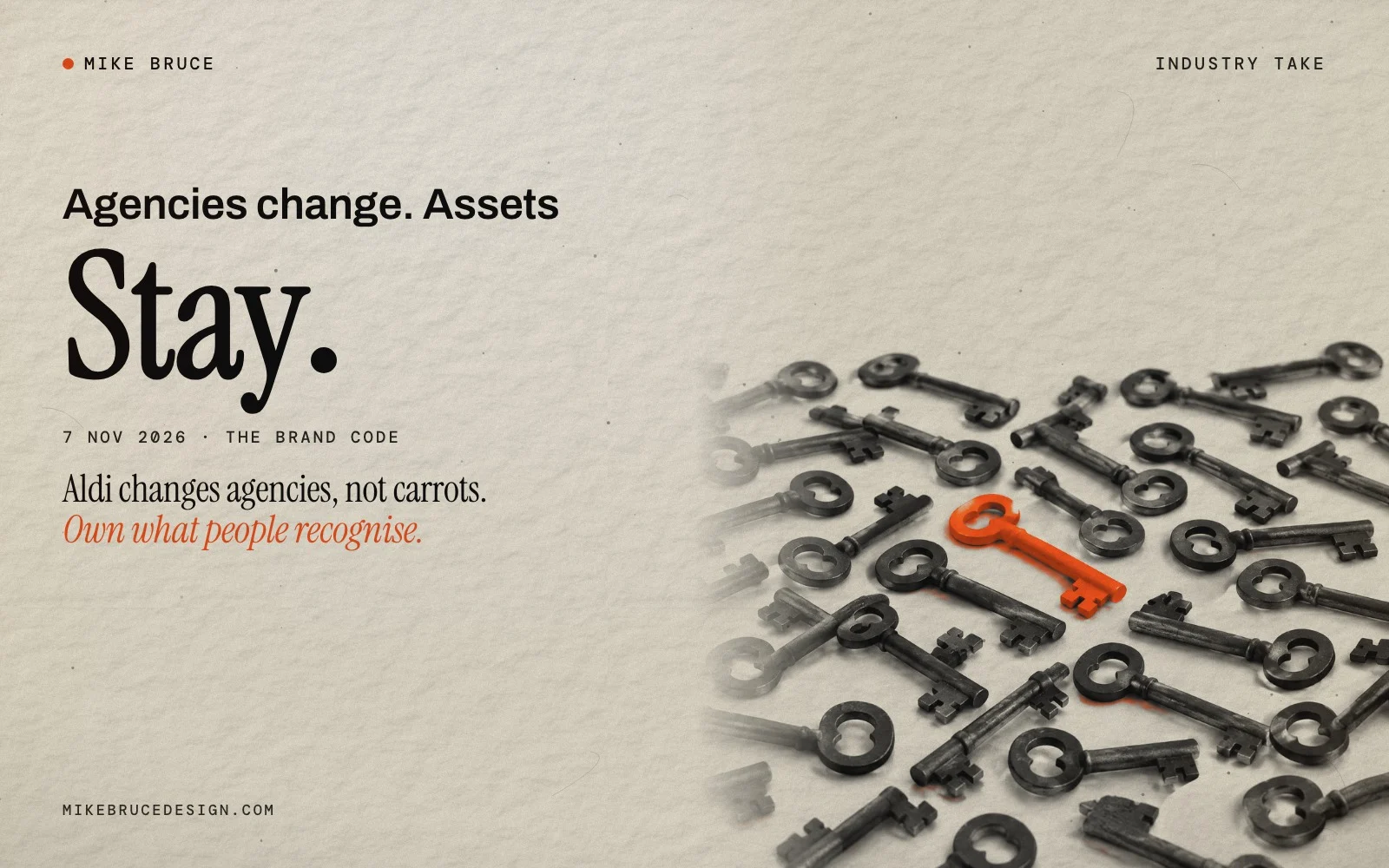
Aldi is changing agencies, not carrots. Your brand assets should outlive your suppliers too.
Aldi UK's 2026 Christmas ad brings back Kevin the Carrot for an 11th time, and trade reports say it is the last one McCann Manchester will make after 21 years on the account. The founder's lesson: a brand asset should belong to the brand, so it survives any change of supplier.
 Mike Bruce · Brand Growth Architect
7 November 2026
On 5 November 2026 Aldi UK's Christmas ad brought Kevin the Carrot back for an 11th time. More About Advertising called it McCann Manchester's last effort for Aldi, and The Stable reported that McCann lost the account this year after 21 years. The carrot is staying on screen this Christmas. The agency that made him is leaving.
发生了什么?
The ad is short. More About Advertising describes a 30-second film with a lost dog and the carrot. The Stable fills in the story: Kevin has lost Cauli Dog, the dog that was the ring bearer when Kevin proposed to Katie last year, and the campaign opened with a teaser of Kevin and his daughter Chantenay putting up lost posters.
The bigger story sits behind the film. More About Advertising reports that Aldi is reviewing its global creative account without Omnicom, McCann's new owner. The Stable puts it more firmly: McCann lost the account. Those are not quite the same claim, and the sources we read did not give a date for the new agency to start. Marketing Week and Prolific North also covered the split, but their pages were not open to us, so nothing here comes from them.
What happens to Kevin?
Nobody we read has said. That is the most interesting question in the story, and it is the one every founder should ask about their own brand.
My take: the asset belongs to the brand, not the agency
This is opinion. Over 11 Christmases a vegetable with a voice has become one of the most recognisable things Aldi owns in the UK. That is what a brand asset is: something people link to you without reading your name. A colour, a character, a sound, a shape, a line.
Assets like that are built slowly and lost quickly. The usual way they get lost is not a bad ad. It is a change of people. A new agency wants to make its mark. A new marketing lead wants a fresh start. The founder who has never written down what the brand owns cannot defend it, because nobody can defend what they have not named.
Agencies are suppliers. Assets are property. Treat them that way.
In Brand Growth OS™ terms this is Construct work: the brand system has to live with the business, not inside a supplier's files or a freelancer's head. Certainty is the brand, and certainty comes from the same signals showing up for years, whoever is making the work.
Aldi is a big company with lawyers. Many small businesses have the opposite setup: the logo source file is on a designer's laptop, nobody knows who owns the jingle, and the brand rules are in an old email. When that supplier goes, the brand quietly resets to zero.
创始人该怎么做?
- Do we own it? Check that your contracts give you the rights to your logo, characters, music and photography, and that you hold the source files, not just the exports.
- Could a new supplier start tomorrow? If your brand guidelines would not let a stranger make on-brand work on day one, write them before you need them.
- What would we never change? Name your three most recognisable assets and make them the brief's fixed points, so a new team adds to them instead of replacing them.
The brand guidelines template helps you write the rules down, and heritage is an asset covers why what you already own is worth keeping. The Brand Growth Audit™ checks which of your signals are doing the work. For the theory of recognisable assets, see my profile of Byron Sharp. See all brand voices or about Mike Bruce.
来源
More About Advertising (5 Nov 2026) · The Stable (6 Nov 2026). The two differ on how settled the agency change is: one says Aldi is reviewing its account, the other says McCann lost it. Opinion is Mike Bruce's; facts are as reported by those sources. See all brand voices.